 In his MOMLOGIC column this week, the Gay Uncle explores the confluences of long-term friendship, pregnancy, and vagina waxing (or, not waxing). Title: “It’s a Jungle Down There”. You have to check it out.
Go Marcus!
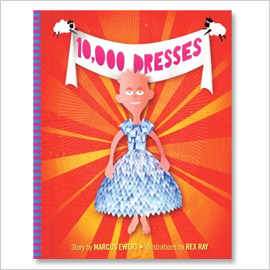 The Gay Uncle just read that Marcus Ewert and Rex Ray’s book 10,000 Dresses was nominated for a Lambda Literary Award. He applauds this, not only because he is a huge supporter of gay and lesbian themed picture books for young kids (particularly ones that don’t suck) as you can read in this piece in Babble, but because he loved Marcus’ book in particular, as expressed in this review in his Momlogic column. Way to go, Marcus.
Paté
 Last night, the Gay Uncle talked to a close friend who recently had twins, bringing the number of children-under-three in his household to three. This means that he and his wife are outnumbered, which, as anyone who has taken a course on military strategy or colonial history knows, means one or more of the following: 1) you need to have superior strength and firepower 2) you need to recruit some of the opposition onto your team 3) you need to bring in reinforcements. It seems that they’re pretty much winning right now. They’re great parents (the mom was an early childhood educator in the past, which helps.) Their older daughter has been enlisted in helping out with the little boys, when she’s not trying to kill them. And they have a balletic parade of child-care assistants coming through their house, including a full time nanny and a rotating crew of evening and weekend sitters–plus their toddler is in preschool. (They’re both doctors and each work more than full time.) But the one area they’re struggling with is sleep. Big surprise with two seven-month olds, right? But it’s not their own nocturnal schedules with which they’re grappling–they had a kid before, they know the deprivation/sonambulary drill. It’s the boys’. Apparently, when one has twins, it’s easier to feed them both at once, rather than run an all-night Dairy Bar. But, ever since these two were in-utero, they’ve had very different personalities–during a get-together last summer, the G.U.’s boyfriend Tal nicknamed them Swimmy and Lazy–which have translated into varied needs in terms of the nighttime lacto-craving. So while active squirmy Swimmy gets hungry ever two hours, and is becoming quite the bruiser, his brother Lazy is a bit more laconic and disinterested. Their solution? They make the scrawny, sated one eat whenever his bigger bro does. “Swimmy gulps it down,” Gunc’s friend told him. “But Lazy? He sort of gets force fed.” The Gay Uncle thought of veal calves, chained up in a pen, and intubated with a giant milk straw, on which they guzzle until their muscles atrophy. (Mmmm. Tender.) But his friend had a different food metaphor. “It’s like those geese they use to make Foie Gras. Open wide!” And you wonder why the G.U. never had kids?
Ad It Up
 The Gay Uncle spent a day in Washington D.C. this week, speaking before members of the Federal Government. No, his testimony was not the result of that silly little extrajudicial transfer flight he took to Jordan during the tail end of the last administration (or was it Syria? Gunc can’t remember. Maybe it was that hood he was wearing the whole time. And the genital Tasering. And all those dogs.) Rather, he was invited to be an expert panelist in a conference on “Children and the Commercial World”, a fact-finding discussion set up to help the Federal Trade Commission create a functional, cool, and motivating program to teach young people Advertising Literacy skills, things like: understanding the tricks and tools of the advertising industry; decoding the origin, motivation and messages embedded in advertisements, and; learning to be smarter, more informed and discerning consumers of our material world. As any of you who have read the Gay Uncle’s spectacular and critically acclaimed book will know, he’s been a big advocate for just this kind of national program for some time. So he was thrilled to be a part of the process. As an added bonus, he learned all sorts of interesting stuff, met some really smart people, and found out that whatever you say to the U.S. Government becomes official public record. (Gulp!) If any of you die-hard fans want to watch him do his wind-up-monkey routine in The District, here’s a link to the webcast. Gunc believes that he said a few smart things, but more than this, was fundamentally impressed by the wisdom of his co-panelists. He’s in Panel 2.
Waitress!
 Check out the Gay Uncle’s column in MOMLOGIC this week, all about how to help those moms who are mired in making different meals for each kid at dinnertime every night. Follow his six quick steps to food freedom.
Be advised, Gunc’s suggestions do not include uttering the words “Kiss my grits!”
Je Suis Fatiguee
 A loyal reader recently wrote in with a note. “For Vol. 2 of Gay Uncle”s Guide, I think you should swap out the wipe warmer references to make room for this gem.” Shut. Up. What is this extraordinarily significant new product that will revolutionize the way in which children are reared during these cruel, pain-inducing times? Well, it’s a patented, fashionable, 100% cotton, washable, biomorphically molded…(wait for it)…Shoulder Pillow!! Oh my god! Is this not exactly what you have been praying to god to deliver? Fuck extending your unemployment benefits, or rebuilding our failing infrastructure, or providing health care for the 50 million folks who lack it. This is IT. No longer will you have to suffer through “shoulder fatigue” after having a little one”s head rest on your deltoids. Unh-uh! Now, both parent and child can immerse themselves in the void of blissful, fibrous comfort. And not only that. The press release describes it as “egonomic”. Ideal for our narcissistic times! Need to burp that baby after a boob juice binge? Compelled to give that toddler a comforting hug when they fall from atop the coffee table? Wanting to greet your three year-old between your three part-time jobs? Don’t rush into things. “Just a sec, darling. Mommy has to go grab her Shoulder Pillow.”
The G.U. was convinced for a nano-second that, with the death of capital, people would stop–or at least significantly retard–their production of this kind of FUNDAMENTALLY MORONIC JUNK. But, according to his pal Heidi Stevens–parenting columnist for the venerable Chicago Tribune (and all-around amazing person)–there is some sort of last gasp going on. “Maybe this is the point just before the bubble bursts, but my PR pitch load has reached extreme levels of late. I don”t know if people are trying to save their jobs by getting some press for their products, or if marketing budgets have been slashed to the point of just hoping for free publicity from the (increasingly irrelevant) press, or maybe a little of both, but I”m getting double the calls and e-mails in the last few weeks. Maybe (hopefully) if the PR stops working, they”ll stop churning the crap out.” So the Gay Uncle predicts that you all are either in for an onslaught of desperate promoters competing for your increasingly limited disposable ching-ching, and/or a new market will develop out of this very desperation, preying on your desire to insulate your precious cargo from the increasingly hostile, painful, and egonomic world.
Armored Bugaboos anyone?
Babbling
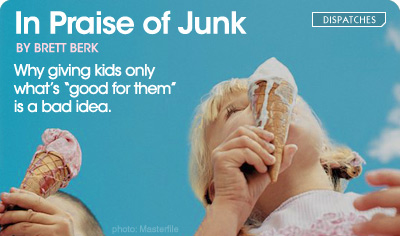 Gunc has a new piece up on Babble, this one called “In Praise of Junk”. It’s all about how to help your kids understand the role of “treats” in their life–and how to provide them with some long-term coping skills for dealing with the seductive nature of things like sweets, chips, TV–without encouraging them to become obese, addicted, or just plain lazy. It’s genius, as usual. He highly recommends you read it (and while you’re there, leave a comment, and/or rate the article: 5 STARS is suggested.)
For those of you who are new to the G.U.niverse, he has scads of other, equally impressive (and intelligent, and persuasive, and actionable) pieces up all over the parenting magazine universe. Just look up at the CLIPS page, or click here to get a taste. Of course, you can also buy his critically acclaimed parenting book and get immersed in raising your kids (and yourself) the Gay Uncle way.
My Breast Friend
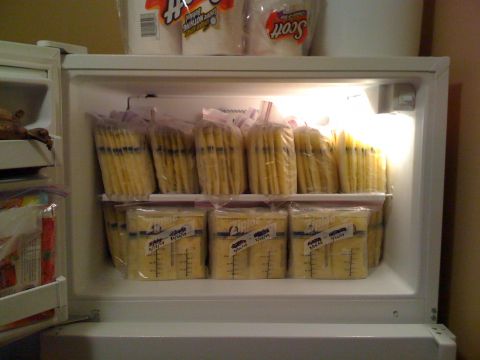 One of the other things the Gay Uncle discovered during his recent whirlwind tour of the homes of his parent (or soon-to-be parent) friends in the Mountain and Central time zones last week was a hidden cache. This is not one of the ordinary secret stashes he’s prone to finding–porn, weed, sex toys, chocolate–stuffed in the bottom of a filing cabinet, the top shelf of a bedroom closet, or crammed into a ceramic pig labeled DRIPPIN’S. Nope. This was a freezer full of breast milk. Well, not precisely full. That would imply a solid block of breast milk in the shape of the frozen foods compartment, sort of like a Rachel Whitread sculpture, but made out of boob juice. Rather, this was a collection of about 11,000 identical ZipLoc bags sluiced with liquid extruded from Gunc’s friend Victoria’s nipples. The Gay Uncle, exhibiting his usual sensitivity, shrieked when the door was opened and this exquisite maternal dairy collection was revealed. And though he knew it was wrong, his first response (aside from his evil mind conjuring the expression that begins “Why buy the cow…”) was to take the photo you now see featured up there in the left-hand corner. His next response was to ask Vicky–who had been regaling him with tales of the sorrows and pities of pumping–how long that amount of La Leche would last? “About five or six months,” she said. “And how long do you plan to nurse the baby?” She squinted. “Until he’s around one or so?” He did some quick calculations on his fingers. “Your baby is six months old now. So, if you stopped pumping today, you’d probably be fine. You have enough. You’re done!” Victoria nodded in that way parents often do when confronted with one of the Gay Uncle’s annoying approximations of a “solution”, and he got the impression that this freezer would continue to experience rounds of PUMP AND DUMP that his friend had described earlier. He closed the door (and his mouth) reminding himself that he’s never been one for things like keeping commodities in reserve, saving for a rainy day, or putting funds into a 401K. Perhaps, he thought, he should start his own PUMP AND DUMP process. But, he wondered, with what precious substance?

Butterballing
 This may come as no surprise to any of you parent types out there, but for The Gay Uncle, a routine drop-by to see his friends David and Celia (while visiting Chicago for work) turned into quite a surprising little voyage into the world of body morphism. It’s only been a month or two since he was last in the windy city, but in that time, Celia’s little bun in the oven has gone and turned into a full loaf. Check this out. This is a very skinny girl, in ordinary times. Now, she’s looking a bit like a frozen turkey around the middle-section. When the G.U. asked these two how they’re feeling about the little bugger, David smiled and said, “Oh, it’s going to be so cute. It’ll be like having a new dog. Something cuddly to take care of.” Celia just rolled her eyes and sighed at Gunc. “Worst decision ever.”
Happy Birthday to GUG
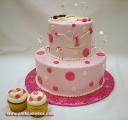 It’s the official birthday of The Gay Uncle’s Guide to Parenting! The book arrived on shelves one year ago. Since then, the Gay Uncle has written close to 700,000 posts and articles, and has participated in all sorts of other humiliating events like radio interviews with hostile shock-jocks, no-audience readings at public libraries, and reality TV show pitches in which he was interrupted mid-sentence and told “We’re really not looking for anything in the parenting space right now.” But it’s all been worth it, because he’s met (and hopefully helped, entertained, and/or humiliated) YOU. So help Gunc blow out his single candle, and then take a sec to participate in the following gunc.com treasure hunt. See if you can find:
1) A way to buy the book
2) A link to join the Gay Uncle on Facebook
3) Myriad interesting articles (called “clips” in the business)
The G.U. wants to thank you for all your support, comments, and questions during this very special year, and looks forward to continuing to inundate you with more of his snarky crap in the upcoming months.